Networking Path Series
Networking Path Series — OSI model.
The core model of everyday network.
Learning Objectives:
- The OSI model with all its layers.
OSI model:
It’s a networking model that categorizes and provides structure for networking standards and protocols on how all network devices can receive, send, and interpret data.
OSI stands for Open Systems Interconnection, created by the ISO (International Organization for Standardization), and consists of 7 layers.
Data starts at the application layer (e.g., your browser data). In every layer, different processes take place, and more pieces of information are added to this data. Data flows throughout this model in three ways:
1- Encapsulation: When data flows from the top layer downward.
2- De-encapsulation: when data flows from the bottom layer upward.
3- Adjacent layer interaction: when the same layer of the OSI model interacts in two different devices.
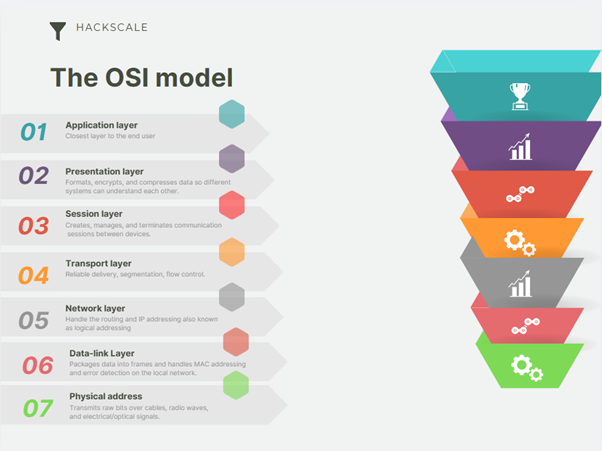
And these layers in detail are:
Layer 7 – Application:
The layer closest to the end user, usually this is the software application the user is interacting with (browser can be an example), here the protocols and rules are mainly determined by how the user can interact with received/sent data.
Layer 6 – Presentation:
This layer is responsible for translating the data from the application layer into another form that we can use to transmit the data over the network. If you send an email, the other user will have another email client, so we need a way to send the content without these 0s and 1s turning into one hell of a mess!
Layer 5 – Session:
Control sessions between hosts communicating, it’s the one responsible for establishing, terminating, and managing connections between local and remote applications.
Software developers are responsible for the 3 layers we have just mentioned, and the rest, which we will mention soon, are what make it the responsibility of being a network engineer!
Layer 4 – Transport:
Here, data gets segmented and reassembled for communication between end hosts, and here we find the most famous network protocols:
• TCP
• UDP
TCP (Transmission Control Protocol) is designed with reliability and guarantees in mind. This protocol keeps a constant connection between the two devices to ensure delivery of the data.
using error checking to ensure the data is sent and received in the same order. TCP is good in cases of sharing files or any case that requires data sending to be accurate.
UDP (user datagram protocol) is a protocol not as powerful as TCP, but it has its use cases; it gives up on error checking, no synchronization, just sending the data and hoping for the best!
While it might sound horrible, it has use cases, since UDP is faster, and in case a loss of data won’t cause a disaster, a use case for it can be video streaming.
Layer 3 – Network:
This is where routing (connection between LANs and determining required routes), and this is where IP addresses get attached to data; routers operate at this level.
Famous protocols can be found in this level of the OSI model, such as OSPF(Open Shortest Path First) and STP (Spanning Tree Protocol). In this layer, we always determine the best path the data can take to arrive at its destination, calculated on how many hops it needs to get there, and the speed we can expect, depending on the physical medium this data takes.
Layer 2 – Data link:
This layer provides node-to-node connectivity and formats data in the right form for transmission over the physical layer (if it will be electrical transmission over copper cable or radio waves transmission via 5G technology or any similar technology).
Layer 1 – Physical:
These are the physical components in the network, like the cables or fiber optic cables, and hardware that is used to transmit data between nodes(devices).